BIM consulting-Cultural venue project-Guangdong
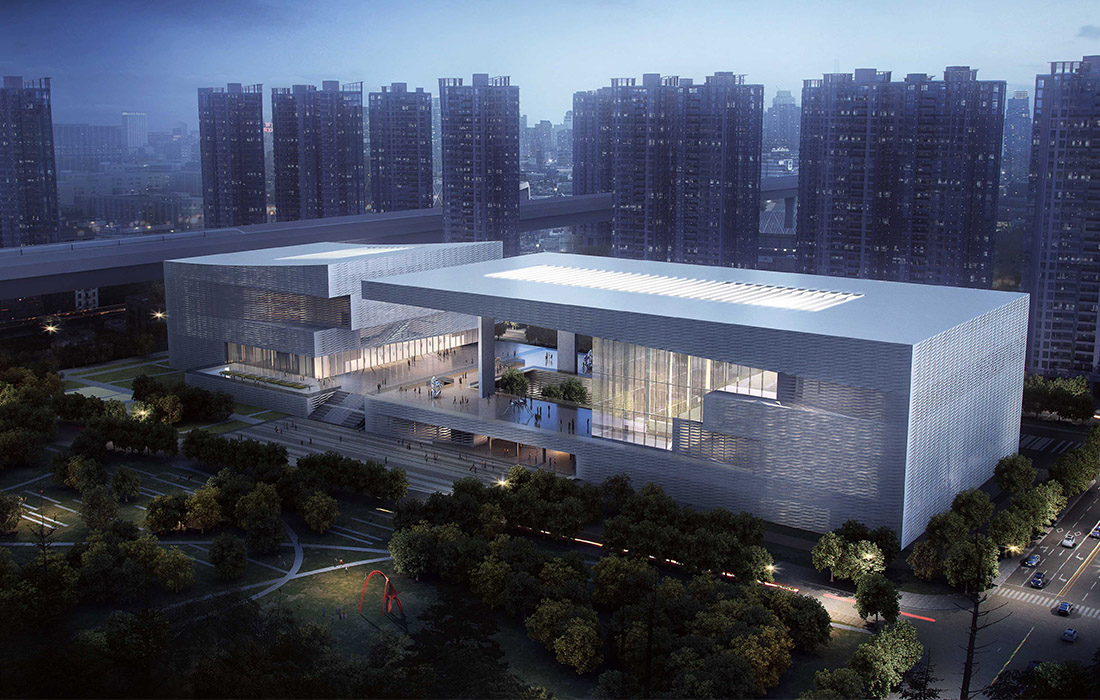
Longhua Cultural and Sports Center Project
This project is located in the business center district of Shenzhen North Railway Station. In the development of the new urban area, it has multiple functions such as culture and art. Among them, the new Shenzhen Art Museum is positioned as a large-scale modern, international and digital comprehensive art museum integrating collection, exhibition, research, exchange, education and promotion. The adjustment book depository of Shenzhen Library is positioned as a fundamental supporting project for the construction of Shenzhen as a "City of Libraries" and an important resource platform for Shenzhen as a "Global Model City for Universal Reading", with over 1,000 reading seats.
The Shenzhen Art Museum serves as a window for showcasing art, a platform for promoting interaction and exchange between Chinese art and international art, a venue for aesthetic education to the public and enriching citizens' culture, and a key area for advancing the development of contemporary art. The Second Library serves as a window to showcase the cultural development process and future construction of Shenzhen, a starting point connecting the present and the future, and a platform for cultural and academic exchanges in Shenzhen.
The company's BIM technology team has been involved since the scheme stage, cooperating with the design team to use 3D models for auxiliary design work. Through BIM technology, they have successively completed auxiliary scheme design, building performance analysis, spatial analysis, pipeline integration, and deepening of seismic support hangers, etc., helping to improve the quality of design drawings.
Secondly, there are four major links: formulating project-level BIM implementation standards, reviewing the quality of results and organizing coordination, and promoting progress. So far, the Whole-process Consulting Department has completed the compilation of one BIM planning scheme, five BIM implementation standard documents, five management processes, seven management systems and related safeguard measures.
Thirdly, the Longhua Two Museums project, as one of the new top ten cultural buildings in Shenzhen, aims to build a high-quality project. To showcase the innovative application of BIM technology in the design stage of this project, facilitate the promotion of BIM technology application, and enhance the project and enterprise's reputation, the Jiangnan Whole Process Consulting Department, in collaboration with the project team of the Public Works Bureau, the Zhubo Design Institute, and the construction unit, the First Company of China Construction Third Engineering Bureau, have jointly planned and proposed to apply for the 11th "Innovation Cup" competition hosted by the China Association of Surveying, Design and Consulting in 2020.
The main highlights of BIM technology application include:
In the early stage of the plan, when analyzing the clear height of the stairwell by creating a civil engineering model, it was found that the clear height of the double-run staircase was insufficient, which would cause a collision. After several discussions with the plan unit, it was finally confirmed to modify the staircase form, add steps and intermediate transition platforms to solve the problem of insufficient clear height.
It took a full year from the proposal to the preliminary design stage. Based on the key and difficult points of this project, a comprehensive professional review was organized. At the same time, a preliminary estimate of the clear height required by the library was made. During this period, 724 items were proposed for review, among which 450 errors, omissions, collisions and deficiencies among different specialties were solved through BIM-based technical optimization, accounting for approximately 62%.
3. To maximize resource conservation, environmental protection and pollution reduction, the analysis of wind, light, sound and heat indicators inside and outside the building is carried out during the scheme design stage, which serves as a reference basis for applying for green and energy-saving buildings.
4. During the construction drawing design stage, based on the design deepening model, pipe integration collision checks are conducted to resolve design issues and those unfavorable to construction before the official start of the project, thereby reducing changes and rework during the construction process.
5. Compared with the original design structure, trusses were added to the exhibition hall of the collections on the 4th floor of the art museum. After the BIM team optimized the route of the HVAC return air system and readjusted the piping system, they found that the clear height could meet the requirements of the museum. Therefore, the BIM team suggested that the building wall originally planned to be used to hide the air conditioning ducts on this floor could be cancelled. After the cancellation, the usable area of the exhibition hall can be increased by 36 square meters. This deepening suggestion was recognized by the architectural professional engineer and was drawn.
6. When the BIM team conducts pipeline integration during the construction drawing design stage, they take into account the issue of setting seismic supports and hangers during construction. They require in-depth design of seismic supports and hangers, technical communication with the manufacturer, clarification of the parameter dimensions of seismic supports and hangers, and construction of the parameter family of seismic supports and hangers. In the pipe integration model, seismic supports and hangers are laid out in accordance with the construction requirements. In this way, the possible insufficient space for the laying of seismic supports and hangers at the construction site in the later stage can be discovered, and the maintenance space after the construction is completed and put into use can be reserved to improve the space utilization rate.
7. Based on the BIM model and the space requirements of the museum, conduct a clear height analysis. Through the model, analyze the factors that affect the clear height of important areas such as the lecture hall, exhibition hall, and public corridors, such as the size of fireproof rolling shutters and the installation space for supports and hangers. After organizing a special meeting for discussion, optimize the elevation and layout of pipelines such as air ducts, cable trays, and water pipes Make the clear height of each floor's rooms meet the requirements of the users.
8. We conducted a meticulous review of the design model (process version), optimized 351 model issues, and formed 11 review reports. This assisted the design BIM team in improving the model, fully leveraging the role of the BIM team in the whole-process consulting department to facilitate the smooth handover of the design BIM model to the general contractor for construction.
9. The design model management integration coordination meeting was organized and held. The meeting discussed and made suggestions on the drawing and model issues identified by the management integration layout of the Zhubo Design BIM team, and resolved a large number of coordination and communication problems, smoothly advancing the progress of design BIM. After the meeting, a BIM professional issue implementation tracking table was also formed.
10. Utilize the design BIM model to conduct statistics on the engineering quantity of prefabricated steel structure components, which serves as a reference for the in-depth processing of steel structures. The steel components of this project mainly use welded non-special-shaped section steel, and the floor slabs adopt reinforced truss floor deck slabs without formwork support. Through BIM technology, the hoisting construction process of prefabricated steel structures is simulated, the hoisting construction plan of steel structures is analyzed and optimized, and finally a simulation video and analysis report are formed to guide on-site construction.
BIM consulting
Shenzhen City, Guangdong Province
China Resources (Shenzhen) Limited
 Tel
Tel
 Business
 Add
Add
Copyright ? 2025 Zhejiang Jiangnan Project Management Co., Ltd. All Rights Reserved.
Zhejiang ICP No. 15025655-1
 Zhejiang Public Security Bureau File No. 33010602007862
By:Doing